E00113-00
AC Socket Panel Mount
$2.99
Add
SKU E00111-00
In stock
One power entry module, Blue Alpine part E00111-00: a black housing that snaps into a panel cutout. Compare the face, terminals and any fuse holder with your old module before you order.
This power entry module is Blue Alpine part number E00111-00, priced at $3.75. It’s a black housing that snaps into a panel cutout. Since a power entry module is where mains power comes into a piece of equipment, five minutes of checking before you order is time well spent.
At its simplest, it’s a panel-mounted inlet: the socket a detachable cord plugs into. Many designs pack more into the same housing, such as a fuse holder, an on/off switch, or a line filter that cuts down electrical noise. A lot of inlets follow the IEC 60320 family of connectors, the same system behind most computer and monitor cords.
Because the combinations vary so much, two modules can share a cutout size and still be different parts. That’s the main thing to rule out.
Compare the old one with our photos, front and back:
Measure the cutout too, and the panel thickness, since snap-in latches only grip within a limited range. If any of this differs from what you see in our pictures, or you can’t tell, phone +1 (443) 514-5708 before buying. Having the part number from your manual in front of you makes that call short.
If your old module has a fuse, its rating is printed on the fuse itself, usually on an end cap. Write it down before anything goes in the trash. A blown fuse should only be replaced with one of the same rating and type. A bigger fuse removes the protection. A fuse that keeps blowing means something downstream has a fault, and that needs finding first. The fuse article covers ratings and types.

Before you start: this is mains wiring. Do it with the machine unplugged, and if you aren’t comfortable with that kind of work, get a qualified person to handle it.
Disconnect any cord from the power entry module itself as well as from the wall. Then photograph every connection on the back, close enough to read the markings. Disconnect the wires, squeeze the latches from behind, and press the old housing out through the front of the panel.
The new power entry module goes in from the front until the latches click home. Reconnect each wire exactly as your photo shows. Ground goes back on ground, every time. Give each connection a light tug to confirm it’s secure before closing up.
With the machine unplugged and the module’s wires disconnected, a multimeter on continuity will tell you a lot. Each inlet pin should read closed to its matching terminal on the back, with any built-in switch turned on. If the module has a fuse, pull it and test it on its own: closed is good, open means it’s blown. A module that tests fine but shows cracked plastic, a loose inlet or brown marks is still worth replacing. Heat damage tends to get worse, not better.
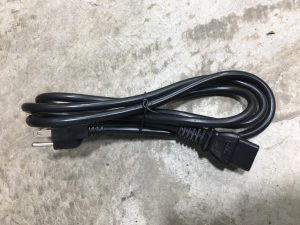
Not necessarily. An undamaged cord can stay in service. If the old inlet was scorched or loose, though, look hard at the end of the cord that plugged into it, because heat damage often shows up on both halves of a bad connection. Check any replacement cord’s part number against your manual.
Other parts on the power side, including the 20 A SPST switch, are in electronics. Questions about which power entry module your machine takes can go to our support team.