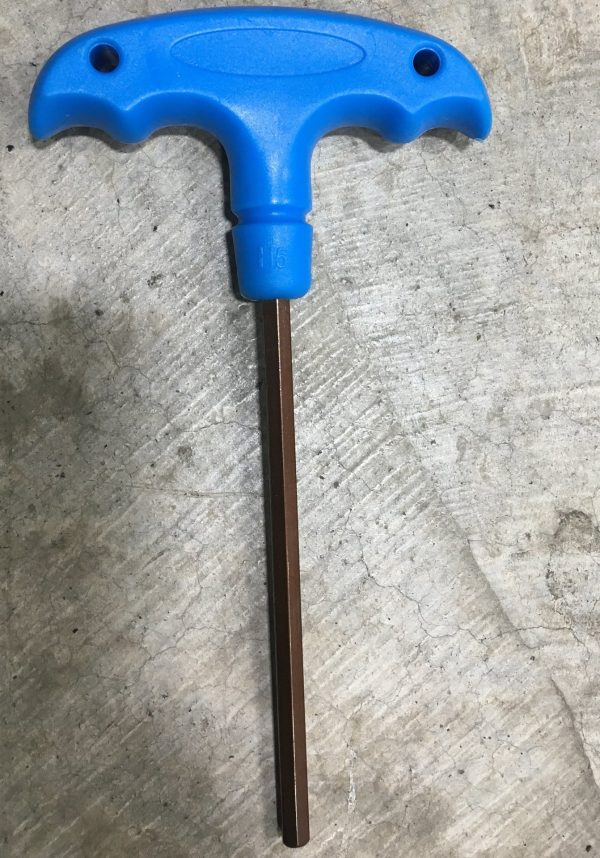
A00112-00
5mm Hex Key Loop T Handle Allen
$3.89
Add
SKU F00119-00
In stock
A pack of ten M4-2 self-clinching nuts in stainless steel, Blue Alpine part F00119-00. Each clinch nut presses into a hole in thin sheet metal and gives it a standard M4 thread. Match the -2 shank code to your part.
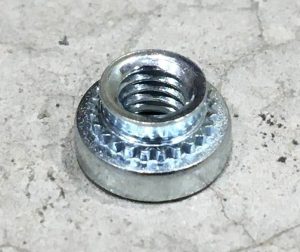
This is an M4-2 clinch nut in stainless steel, Blue Alpine part F00119-00, sold in a bag of ten for $2.50. Pressed into a hole in thin sheet metal, it gives the panel a full M4 thread with no welding, no tapping and no loose nut held behind it.
Two features do the work. There’s a knurled collar where the body meets the shank, and just below it the shank is cut back into a narrow groove called the undercut. You set the nut in a plain round hole and squeeze. The collar sinks into the sheet, and the metal it pushes aside has nowhere to go except sideways into that groove.
After that, the knurl keeps the nut from turning when you tighten a screw into it. The metal packed into the undercut keeps it from pushing back out of the hole. No heat, no adhesive, no thread cut into the panel. The sheet itself becomes the lock. That’s the whole trick of a clinch nut.
You’ll also hear them called PEM nuts. PEM is PennEngineering’s brand of self-clinching hardware, and like plenty of trade names it turned into the everyday word for the whole type. Wikipedia files them under swage nut if you want the background.
M4 is the thread: 4 mm nominal diameter at the standard coarse pitch of 0.7 mm, so it takes ordinary M4 machine screws. The 2 after the dash describes the shank. Shank length sets the minimum sheet thickness the nut can be installed in, and the maker’s spec for that code lists the hole size to go with it.
Why care? A clinch only works if there’s enough sheet around the shank to fill the undercut. Put a nut into sheet thinner than its code allows and the shank sticks out the back with too little metal displaced, so it can spin or pop loose under load. In the usual coding a higher number means a longer shank and a heavier minimum sheet, which puts this M4-2 on the thinner side of our M4-3 self clinching nut.
We don’t publish the millimeter figures for each code, and we’d rather not guess at them here. Find the code in your manual’s parts list, or on the paperwork for the original part, and order that exact one. Swapping a -2 for a -3 because it looks close enough is how you get a clinch nut that won’t stay put.

This is press work. A hammer gives a sharp, lopsided hit. The nut tilts, the displaced metal fills one side of the undercut more than the other, and sometimes the thread distorts as well. What you want is a slow, even squeeze between two flat faces held parallel to each other, from an arbor press or a proper fastener press.
The usual complaint is a screw that turns and turns without tightening or coming out. That means the knurl has let go and the clinch nut is rotating with the screw. Overtightening causes it. So does a cross-threaded screw forced home.
If you can get at the nut side of the panel, hold the body with pliers while you back the screw out. Expect the hole to be slightly bigger once a nut has torn loose, and a new one pressed into a worn hole may not grip like the first. Measure the hole before deciding how to repair it.
Ten M4-2 nuts per bag, in stainless steel, which resists corrosion in damp, condensing conditions far better than plain steel. Screws to suit are in fasteners and tools, listed by thread, length and drive. Not sure your part is a -2? Send a photo and the number from your manual through our support page, or ring +1 (443) 514-5708, and we’ll help you match it.


